

Getting help to understand and find services
It can be hard to know which services are right for you. Different services have different rules about who can use them. If you are not sure where to start, there are local services that can help you work this out and connect you to the right support. Click the blue box below to find out how this works in in Leicester, Leicestershire and Rutland.
Getting help to understand and find services - in Leicester, Leicestershire and Rutland
Leicester
Local area coordinators (LACs)
Local area coordinators help you understand what support is available in your community. They can:
- listen to what matters to you
- help you plan what support you need
- connect you to local groups and services
- help you stay independent
To find contact details for Leicester LACs, visit: www.leicester.gov.uk/health-and-social-care/adult-social-care/local-area-coordination/
Social prescribers
Social prescribers (sometimes called link workers) help you with non-medical needs. They can:
- help you think about what support you need
- suggest services and activities
- help you contact services or make referrals
You usually access a social prescriber through your GP surgery. Ask your GP or reception team if this is available.
Leicestershire
Local area coordinators (LACs)
Leicestershire has local area coordinators working in different areas. They can:
- help you understand your options
- support you to find local services
- work with you to build a plan that suits you
You can find contact details for your area here: www.leicestershire.gov.uk/sites/default/files/2023-09/LAC-contact-details.pdf
Social prescribers
Social prescribers can support you to:
- understand your needs
- find the right local support
- get help to access services
You usually need to ask your GP surgery for a referral. Some GP practices may let you refer yourself, so check with your practice.
Rutland
Early support care co-ordination (ESCO)
Rutland has ESCO instead of local area coordinators. ESCO can help families to:
- understand what support is available
- coordinate services around your needs
- plan the next steps
You can contact ESCO by calling the Early Help Front Door on: 01572 758 493
Find out more here: www.rutland.gov.uk/rutland-information-service/directory/5u5059zklr0
Social prescribers
Social prescribers can help you:
- work out what support you need
- find services and activities
- access or apply for support
You can ask your GP surgery about social prescribing. They can tell you how to get an appointment.
Care Navigators for children and young people 0-19
Care Navigators at Leicestershire Partnership NHS Trust (LPT) help children and young people (0–19) and their families understand health services and find the right support.
They can:
- explain what services are available
- help you find the right support
- share information between professionals (with your consent)
- give updates about referrals and appointments
- be a point of contact if you are unsure what to do
They work across Leicester, Leicestershire and Rutland, with a care navigator in each area.
How to access
You can be referred by a professional (like a GP, school or health worker)
Some families can contact the service themselves
Phone: 0116 215 3269
Website: www.leicspart.nhs.uk/service/care-navigation/
Important
This service is mainly for children and young people (0–19)
They need your permission to share information
Summary
Care Navigators help organise and explain health support for children and families
Adults are more likely to get this kind of help from Local Area Co-ordinators (in Leicester and Leicestershire), and Early Support Care Co-ordinators ESCOs (in Rutland) – or from Social Prescribers (via their GP).
Education Support Services
Leicestershire SEND hub
Leicestershire SEND hub
The Leicestershire SEND Hub is a parent carer led organisation for families of children and young people with additional or special educational needs and disabilities (SEND) who live or access services in Leicestershire. They aim to be a bridge between parent carers and their service providers.
For more information about this organisation, click the following link:
Leicester City's SEND local offer
Leicester City’s SEND local offer
Information and guidance that can support children and young people with SEND, aged 0 to 25, in Leicester.
SENDIASS (Special educational needs, disability, information, advice and support service)
SENDIASS provide information, advice and support for parents and carers with a child or young person who needs support or adaptations in school or college due to learning difficulties,disabilities, differences or needs – or physical disabilities
Children with such needs are often described as having ‘special educational needs or disabilities’ or ‘SEND’. For more information about SEND, including information about Education Health and Care Plans, click here
There are 3 separate SENDIASS services – for those living in Leicester City, Leicestershire County and Rutland.
See below to find out more about the SENDIASS service in your local area
_______________________________________________________________________________________________________________________________________________________________
SENDIASS Leicester City
Providing free, confidential, impartial information, advice and support for children and young people 0-25 with special educational needs and disabilities and their parents/carers in Leicester City.
Information, advice and support is provided relating to educational needs, social care and health.
Who can access this support?
Children and young people aged 0-25 years old with special educational needs and/or disabilities and their parents/carers. No diagnosis is required and it’s a completely free service.
Referral process
You can self refer via:
- Phone: 0116 482 0870
- Email: info@sendiassleicester.org.uk
- Website: https://sendiassleicester.org.uk/
- Facebook: Sendiass Leicester
- Twitter: @SendiassL
Click here to visit the SENDIASS- Leicester City website for more information.

___________________________________________________
SENDIASS Leicestershire
Providing legally based, impartial information and advice on special educational needs and disabilities including education, health and social care issues.
They provide information and support to enable parents/ carers, children and young people to participate fully, make informed decisions and ensure their voice is heard.
Who can access this support?
Parents and carers with children or young people aged 0-25 that have special educational needs or disabilities, or children and young people themselves who are living in Leicestershire. No diagnosis is required and it’s a completely free service.
Referral process
Self referral via the telephone helpline on 0116 305 5614. This duty line is open 9am-3pm Monday to Friday with a voicemail system in place outside of these hours. Please be aware that the duty line is very busy.
Alternatively, you can email: info@sendiassleicestershire.org.uk
Click here to visit the SENDIASS- Leicestershire website for more information.
Click here to view the SENDIASS- Leicestershire general information leaflet.
Click here to view the SENDIASS- Leicestershire leaflet for children and young people.
___________________________________________________
SENDIASS Rutland
Providing free, confidential, impartial information, advice and support for children and young people 0-25 with special educational needs and disabilities (SEND) and their parents/carers in Rutland.
Information, advice and support is provided relating to Education Health and Care Needs, Assessments and Plans and matters relating to social care and health.
Who can access this support?
Children and young people aged 0-25 years old with special educational needs and/or disabilities and their parents/carers. No diagnosis is required and it’s a completely free service.
Referral process
Self referral via:
Phone – 0797 701 5674
Email – info@sendiassrutland.org.uk
Website – https://sendiassrutland.org.uk/
Facebook – SENDIASS Rutland
Twitter – @sendiassR
The learning, communication and interaction (LCI)- Leicester city schools
The learning, communication and interaction (LCI)
The learning, communication and interaction (LCI) team aims to provide efficient and effective support on an individual, group or whole school basis for pupils with learning, communication and interaction special educational needs.
The team provides every city school with a designated LCI teacher to support children with a variety of learning difficulties. These include:
- General learning difficulties
- Dyslexia
- Dyspraxia
- Dyscalculia
- Autism
- Speech language and Communication Needs (SLCN)
The team provides a variety of training for schools and individual support for pupils including the following:
- Speech and language training
- Dyslexia
- Dyspraxia
- Play Interaction
- Specific interventions in school
For more information about LCI contact 0116 454 2240.
Mental Health Support Teams in schools
Mental Health Support Teams in Schools (MHST)
Support for children and young people in Leicester, Leicestershire and Rutland
What is MHST?
- MHST is an NHS service that supports children and young people’s mental health in school
- It is part of a national programme to improve access to early mental health help and support
Who is this for?
MHST supports children and young people aged 5–18 who are in participating schools.
It helps with everyday mental health challenges, including:
- Feeling low or unhappy
- Worry and anxiety
- Avoiding things (e.g. school, social situations, separations)
- Panic feelings
- Sleep difficulties
- Feeling irritable or overwhelmed
- Finding it hard to solve problems or manage thoughts
This is an early support service
It is not for severe or complex mental health needs (your GP can help with this)
What support looks like
Children and young people can get support in a way that works for them:
- 1:1 support in school
- Small group sessions with peers
- Whole class or school activities
Support may include:
- Talking through worries in a safe space
- Learning practical coping strategies
- Understanding thoughts, feelings and behaviours
- Building confidence and problem-solving skills
Types of help offered
MHST uses evidence-based approaches, including:
- Low intensity Cognitive Behavioural Therapy (CBT)
- Mindfulness and calming techniques
- Sensory strategies
- Creative problem-solving
- Thought-challenging tools
- Practical everyday strategies
What is CBT?
CBT helps children understand how these are connected
- Thoughts
- Feelings
- Body sensations
- Actions
They learn ways to:
- Notice unhelpful patterns
- Feel more in control
- Try new ways of coping
Support for parents and carers
Parents and carers are an important part of your child’s support.
MHST can:
- Help you understand your child’s needs
- Share strategies you can use at home
- Offer parent groups (often online) ???online training (where appropriate)?
How MHST works in schools
MHST works closely with schools to create a supportive environment for everyone.
This includes:
- Working with the school’s mental health lead or pastoral support
- Training staff
- Running assemblies and workshops
- Supporting a whole-school approach to wellbeing
How to get support
If your child attends a school with MHST:
You can:
- Speak to a teacher or school staff member
- Contact the school mental health lead or pastoral team
- Encourage your child to speak to the MHST practitioner in school
- You can use self-referral (My Self Referral service) www.myselfreferral-llr.nhs.uk/
- If you use My Self Referral, you will be directed to the most appropriate support. This might not be the MHST The team will decide the most suitable suppor.t
Important things to know
- The school usually makes referrals, with consent of parents
- MHST can also offer advice and signposting if another service is more suitable
Schools with MHST
MHST is available in many schools across Leicester, Leicestershire and Rutland.
www.healthforkids.co.uk/leicestershire/introducing-the-mental-health-support-team-in-schools/
www.healthforteens.co.uk/leicestercity/introducing-mental-health-support-team-schools/
www.leicspart.nhs.uk/service/mental-health-support-teams-in-schools-mhst/
Contact
- Email: llr.mhst@nhs.net
Key points
- Early support can make a big difference
- Mental health support should feel safe, respectful, and tailored to each child
Alternative education schemes
Soft touch Arts
Soft Touch Arts is a Leicester based arts education charity, who run a variety of projects for young people. These projects aim to improve the lives of those who may otherwise struggle to access services and activities.
Creative Studio is an alternative education scheme run by Soft Touch Arts – and funded by schools and local authorities.
It is a tailor-made specialist alternative arts programme for young people who need extra support and don’t fit into a traditional educational setting. The service specialises in working with young people who need extra support, including those who are autistic.
Soft Touch are currently running regular evening music sessions, led by instrumentalists, producers and contemporary musicians.
Click here for more information and a link to the referral form.
Soft Touch have a constantly evolving range of projects on the go – for more information click here to go to their website.
Legal education advice
Independent Provider of Special Education Advice
IPSEA offers free and independent legally based information, advice and support to help get the right education for children and young people with all kinds of special educational needs and disabilities (SEND). Click this link to go to their website.
Not in education employment or training inclusion (NEET)
Leicestershire inclusion service
Leicestershire inclusion service
If you’re concerned about a child’s or young person’s access to, or inclusion in, high quality education, employment, or training in Leicestershire click this link for more information.
Home education
If your child is in a school in Leicestershire
If you decide that elective home education is the right option for you child, it’s vital to understand what that entails before making any decisions. Click this link for more information.
If your child is in a school in Leicestershire and you decide to home educate
If your child is in a school in Leicester
If your child is in a school in Leicester and you decide to home educate
For Friends and peers of autistic children in schools
Autism Outreach Youth Forum
The Autism Outreach Team Youth Forum have designed the following posters for schools:
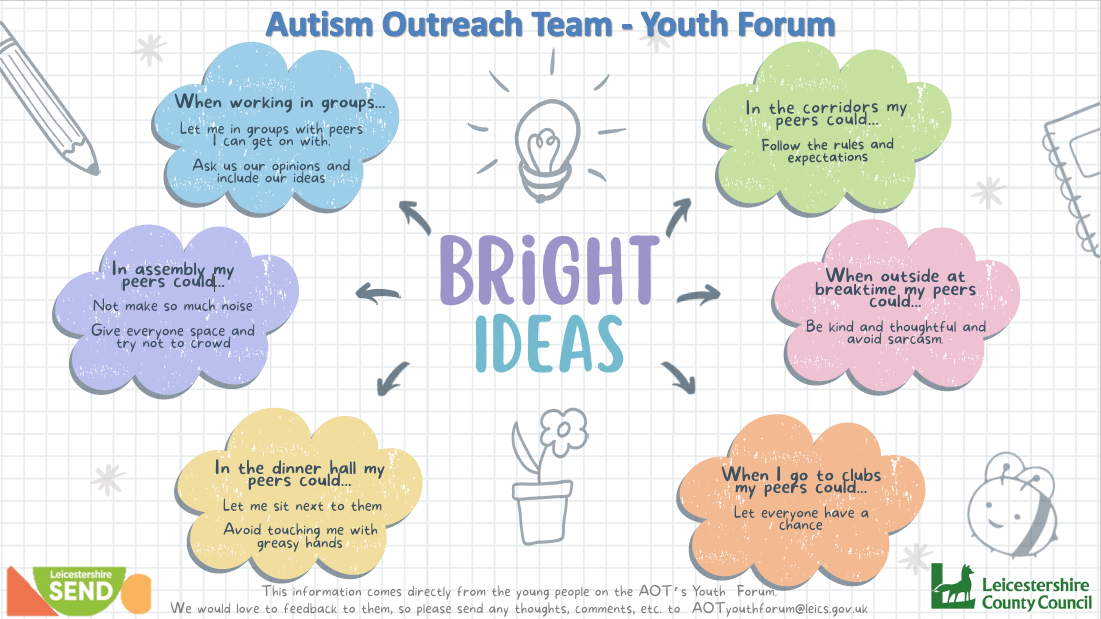
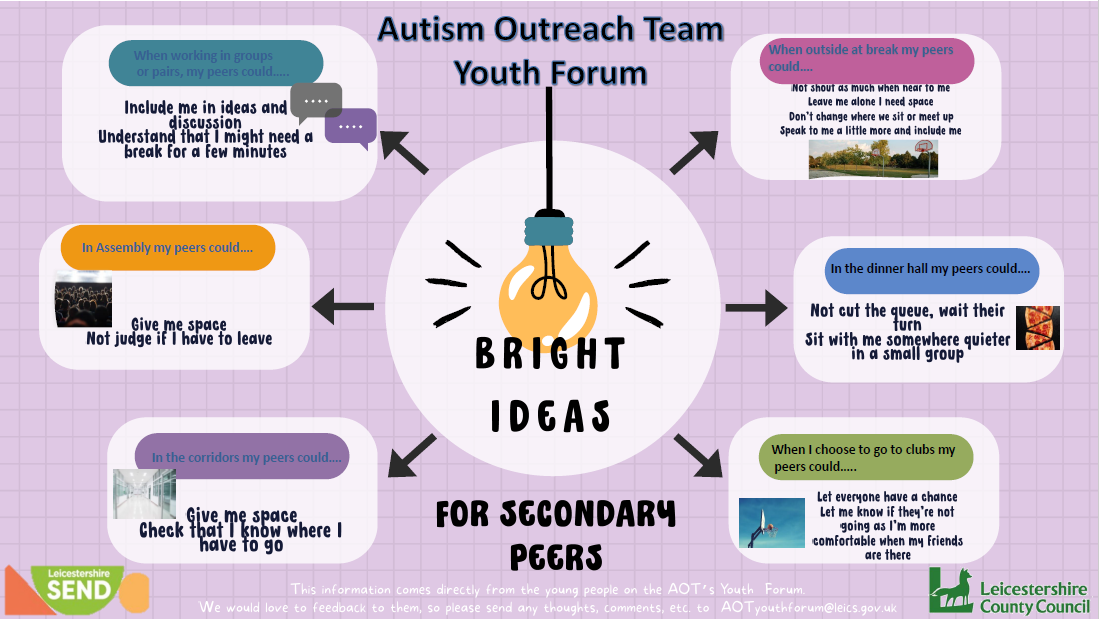
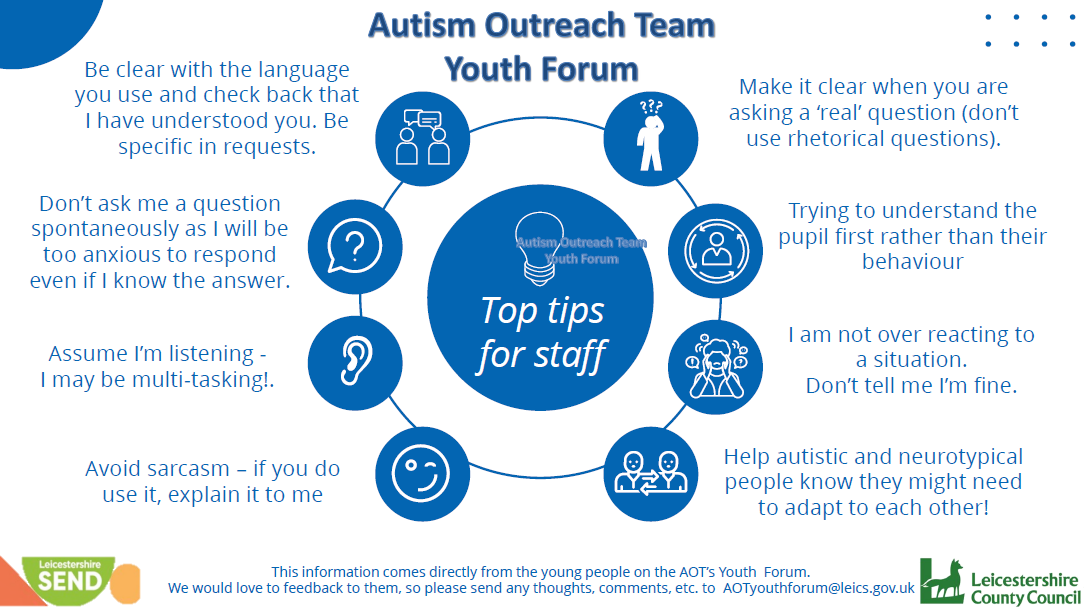
Click here to view or download these as a pdf
The Youth Forum is made up of secondary age young people who all have an autism diagnosis. The ideas were generated by the young people and they were involved at all stages of the creative process. It has been shared with all Leicestershire Schools.
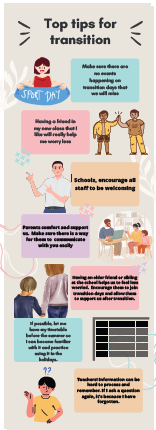
Click here to view the transitions infographic as a PDF
Autism Outreach Team See more information and resources about autistic children in school and transitions on their webpage
Exams
Health for teens Leicester - Exams
Specific help with Exam stress or you’re not sure where to turn first
Support for neurodivergent and disabled university students in Leicester, Leicestershire and Rutland (LLR)
General information for neurodivergent and disabled university students in LLR
General information for neurodivergent and disabled university students in LLR
General information for neurodivergent and disabled university students in LLR
There are three universities in Leicester, Leicestershire and Rutland:
- University of Leicester
- De Montfort University (DMU)
- Loughborough University
Autism, ADHD and other neurodivergent conditions are recognised disabilities under equality legislation. Students with neurodivergent conditions, mental health conditions, long-term health conditions, specific learning differences (such as dyslexia or dyspraxia), sensory impairments and physical disabilities can access support from their university and may also be eligible for Disabled Students’ Allowance (DSA). Each university has its own student support or disability support service, which can help students access reasonable adjustments and support throughout their studies.
If you are autistic, have ADHD or another neurodivergent condition, or have any other disability, all three universities offer specialist support. This may include mentoring, study skills support, exam adjustments, accommodation support, transition support when starting university, wellbeing support and help applying for Disabled Students’ Allowance. Students are encouraged to contact their university’s disability or student support service as early as possible, ideally before starting their course, so that appropriate support can be discussed and arranged in advance.
Disabled Students' Allowance (DSA)
Disabled Students’ Allowance (DSA)
Disabled Students’ Allowance (DSA) is government funding to help cover the additional study-related costs that students have because of a disability, long-term health condition, mental health condition or specific learning difficulty. DSA does not need to be paid back and is not based on household income.
Who can get DSA?
You may be entitled to DSA if you:
- have a disability, long-term health condition, mental health condition, autism, ADHD, dyslexia or another specific learning difficulty
- are studying an eligible higher education course
- meet the residency and student finance eligibility requirements
It is available to students studying higher education courses. This includes:
- Undergraduate degrees
- Postgraduate degrees
- Foundation degrees
- Higher National Diplomas (HNDs)
- Higher National Certificates (HNCs)
- Some distance learning and Open University courses
- Some higher education courses delivered at further education colleges [gov.uk], [disability…ghtsuk.org], [practition….slc.co.uk]
A person studying at a college may be eligible for DSA if their course is classed as higher education, but students on most further education courses (for example A-levels, GCSEs or many vocational courses) would not receive DSA. Different support arrangements are available for those students.
What support can DSA provide?
Depending on your individual needs, DSA can help pay for:
- specialist equipment, such as a computer or assistive technology
- specialist software and training
- study skills support
- specialist mentoring, including autism and mental health mentoring
- non-medical helpers, such as note-takers or interpreters
- disability-related travel costs
What happens after you apply?
If your application is approved, you will usually be invited to a needs assessment. This is an informal discussion about the support that may help you to study. It is not a test. Following the assessment, you will receive recommendations and details of the support you can access.
How to apply
Information about eligibility and applications can be found on the GOV.UK website: www.gov.uk/disabled-students-allowance-dsa
Application forms and guidance: www.gov.uk/government/publications/disabled-students-allowance-application-forms-and-notes-for-2026-to-2027
University of Leicester – AccessAbility Centre
University of Leicester – AccessAbility Centre
The AccessAbility Centre provides support for disabled and neurodivergent students at the University of Leicester. This includes autistic students, students with ADHD, dyslexia and other specific learning difficulties, as well as students with mental health conditions, sensory impairments, mobility difficulties and long-term health conditions. Specialist advisers can work with students to identify their support needs and help them access appropriate support throughout their studies.
What support is available?
Registered students may be able to access:
- one-to-one specialist mentoring
- support with time management and organisation
- study skills support tailored to individual needs
- help with planning work, revision and exam preparation
- exam arrangements, such as extra time or a separate room
- reasonable adjustments to teaching and assessment
- additional orientation support when starting university
- support with accommodation needs
- guidance on applying for Disabled Students’ Allowance (DSA)
- access to study space within the AccessAbility Centre
- advice about obtaining medical evidence and the diagnostic process
The team can also meet with students before they start university to discuss support needs, accommodation and becoming familiar with the campus.
Who can access this support?
Any student who is:
- considering applying to the University of Leicester
- has applied to the University of Leicester
- already registered as a student
To access the full range of support once enrolled, students will usually need evidence of a disability, long-term health condition or neurodivergent condition, or evidence that they have been referred for assessment.
How do students access support?
Students can:
- disclose a disability or neurodivergent condition through their UCAS application
- contact the AccessAbility Centre directly
Email: accessable@le.ac.uk
More information: le.ac.uk/student-support/accessability
The University welcomes disabled and neurodivergent students and encourages students to make contact as early as possible so that support and reasonable adjustments can be discussed and put in place before starting their course
De Montfort University Disability Advice and Support
De Montfort University (DMU)
DMU’s Disability Advice and Support service supports students with a wide range of disabilities and neurodivergent conditions, including autism, ADHD, dyslexia, dyspraxia, mental health conditions, sensory impairments, long-term health conditions and physical disabilities.
What support is available?
Support may include:
- assistance with disabled students’ allowance applications
- identification of reasonable adjustments
- liaison with academic departments and university services
- study needs assessments
- exam support and exam adjustments
- advice about disability-related support across university life
- screening and referral pathways for autism, ADHD and specific learning difference assessments
Students who suspect they may be autistic, have ADHD or another specific learning difference can access screening and guidance about the next steps towards diagnosis. Diagnostic assessment reports can be used to support applications for adjustments and DSA.
Who can access support?
Prospective and current students with disabilities, long-term health conditions, mental health conditions or neurodivergent conditions can access the service.
How to access support
Students can arrange appointments through DMU’s student support services or contact the Disability Advice and Support team directly.
Email: disability@dmu.ac.uk
Wellbeing enquiries:
Email: wellbeing@dmu.ac.uk
Further information: www.dmu.ac.uk/current-students/student-support/wellbeing-disability/disability-advice-support/index.aspx
DSA information: www.dmu.ac.uk/healthy/be-you/disabled-allowance.aspx
Loughborough University Student Services Disability Support
Loughborough University
Loughborough University’s Student Services Disability Support team supports students with a wide range of disabilities, including autism, ADHD, dyslexia, long-term health conditions and other neurodivergent conditions.
What support is available?
Support can include:
- advice before starting university
- guidance about disabled students’ allowance
- help securing suitable accommodation
- transition support and events for new students
- exam and assessment adjustments
- one-to-one study support and mentoring
- specialist study skills support
- access to assistive technology and software
- additional library support
- liaison with academic departments to arrange reasonable adjustments
- access to wellbeing services
For autistic students, the Disability Support team can discuss individual needs before arrival and help ensure support is in place from the start of university.
Who can access support?
Support is available to applicants and current students with disabilities, neurodivergent conditions or long-term health conditions. Students should register with the university and provide appropriate evidence in line with university guidance.
How to access support
Students can register through Loughborough University’s Disability and Health Portal or contact Student Services.
More information:
www.lboro.ac.uk/services/student-services/category/disability-support/
Autism-specific support:
www.lboro.ac.uk/services/student-services/topics/autistic-spectrum-conditions/
_________________________________________________________
For links to all our school related articles, please click here
_________________________________________________________________________