

What visual support is
Visual supports are tools you can see that help explain, remind, or guide.
They can include:
- real objects
- photos of items or places
- drawings or pictures
- symbols that represent words
- written words
- digital visuals, such as on a phone or tablet
Visuals can be used on their own or alongside speech, depending on individual need.
Why visual support helps
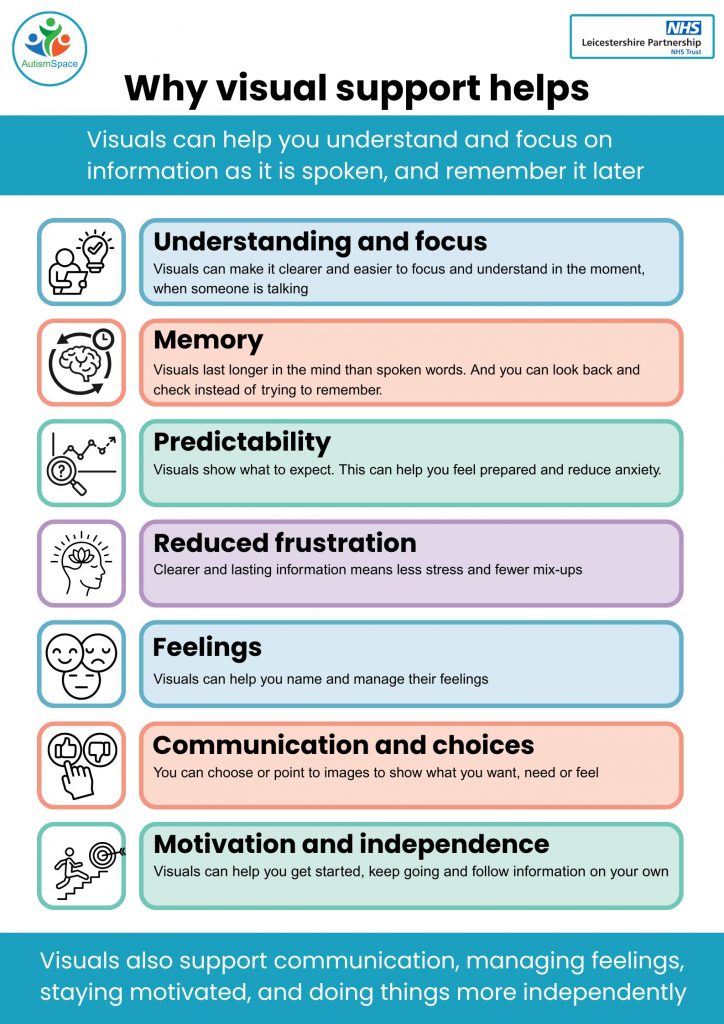
For a downloadable PDF of the above infographic, click here: Why visual support helps
Many autistic people find spoken language fast, unclear, or hard to remember. Visuals help by making information more stable and easier to process.
- Visuals last longer than speech
Spoken words disappear as soon as they are said. Visuals stay there to look at again. - Visuals reduce memory load
You do not have to hold everything in your head. You can check the visual when you need to. - Visuals support understanding of language
Pictures and symbols make ideas clearer and more concrete, especially if words feel abstract. - Visuals support expressive communication
When speech is hard, a person can point to, select, or use visuals to express needs and ideas. - Visuals support emotional understanding and regulation
Visuals can help people recognise and name feelings, understand what is happening in their body, and remember ways to cope or calm down. - Visuals reduce frustration
Clearer understanding and communication lead to fewer misunderstandings and less stress. - Visuals support attention and independence
Visual routines and reminders help people stay on track without needing repeated prompts.
Visual support and AAC
AAC includes any way of supporting communication when speech is not enough.
Many AAC systems use:
- pictures or symbols
- communication boards or books
- apps on devices
These tools can help someone:
- understand what others are saying
- express what they want, need, think, or feel
Visual support is often part of AAC, but visuals can also be used in other ways, such as planning routines or managing anxiety.
Visuals support different areas of everyday life
Visual supports are not only for communication. They can help across many areas, such as:
- understanding routines
- following steps in tasks
- making choices
- remembering information
- preparing for changes
- managing anxiety
- understanding social situations
- building independence
For example, a visual timetable can help someone know what is happening next. A checklist can help someone complete a task. A feelings chart can help someone show how they feel.
Visuals support social understanding
Social situations can be hard to understand because they often follow unwritten rules. These are rules that people expect, but do not always explain clearly. They can include how to communicate, behave, and respond to others. These rules can change depending on the situation, place, or people, which can make them confusing and harder to follow.
Visuals can help explain:
- what is to expect about the situation or environment
- what other people might do
- what the autistic person can do
Carol Gray developed Social Stories™ to explain situations using simple words and pictures.
You can also make your own visual supports in a similar way. These can help with situations like:
- going to an appointment
- meeting new people
- learning social ‘rules’
Visuals support independence and wellbeing
Visual supports can help people:
- rely less on others for reminders
- feel more in control
- understand what is expected
- manage changes and uncertainty
Support emotional wellbeing by providing:
- clear plans for stressful situations
- reminders of positive activities
- ways to track progress and achievements
For information and ideas on how to use visuals to support autistic people, click the following link:
Key points
- Visual supports use objects, photos, pictures, or symbols to make communication clearer
- Some visuals are part of AAC, which supports communication when speech is not enough
- Visuals help because they stay visible, giving more time to understand and remember
- They support understanding, communication, memory, and independence
- Visuals can reduce anxiety and frustration
- They can be used in many areas of daily life, not just communication
- Visuals can support social understanding and emotional wellbeing
- Anyone can use visual supports and adapt them to their needs