

What is LGBTQI+?
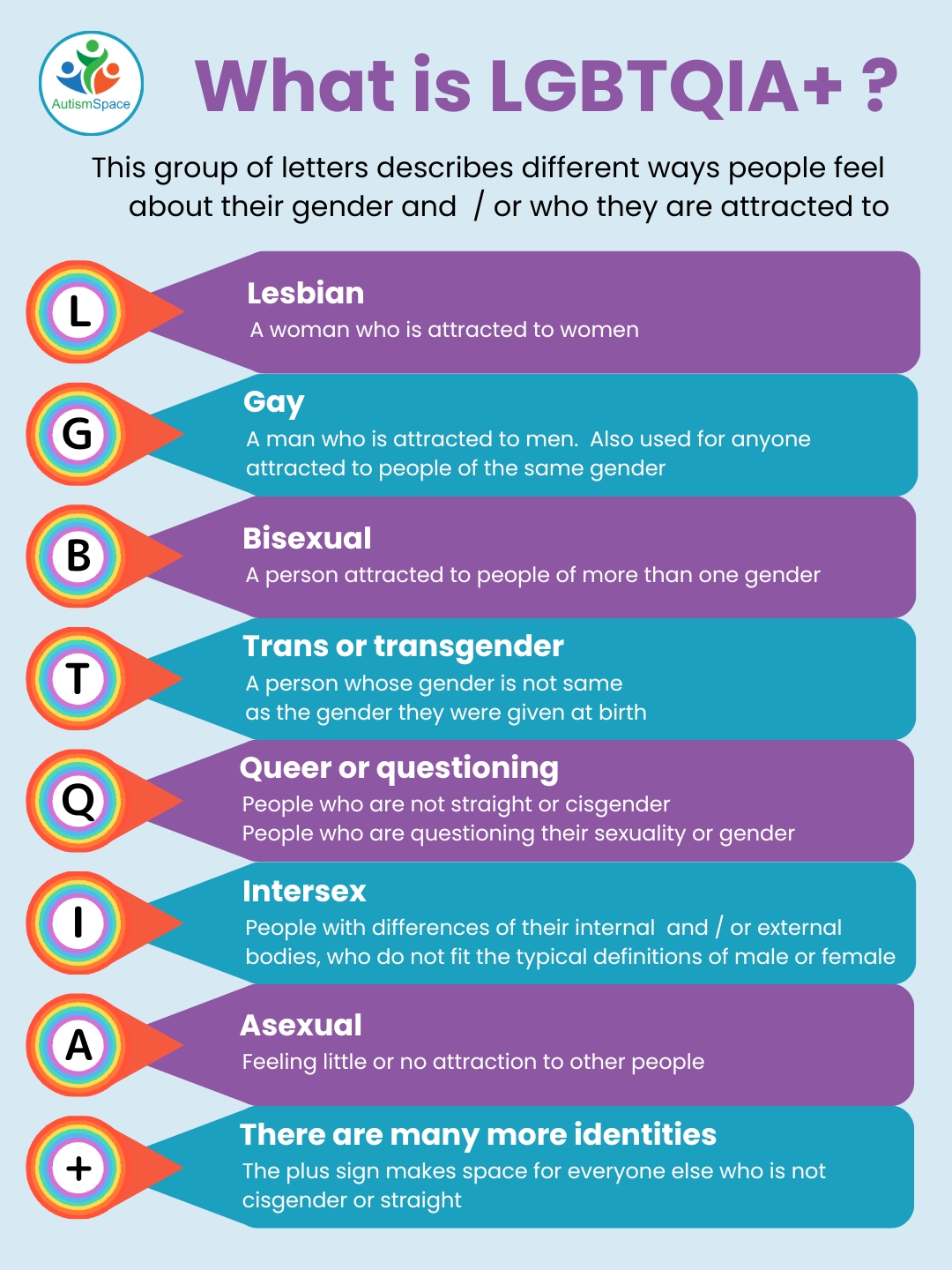
Cisgender: This means a person whose gender is the same as the gender they were given at birth
Straight: This means a woman who is only attracted to men, or a man who is only attracted to women. The formal word for straight is ‘heterosexual’
For more detailed explanations of sexuality and gender, click here (insert link)
Links between autism and differences in sexuality and / or gender
Research shows autistic people are more likely than non‑autistic people to have differences in their sexuality or gender. It is also more common for autistic people to be trans than for people who are not autistic. For many autistic people, learning about who they are, who they like, and how they understand their gender can be an important and positive part of their life.
- Autistic people with these differences are all unique
- Some feel happy and settled and do not need any extra support
- Others may want support at certain times in their life
- Support might include someone to talk to, help with relationships, or help to feel safe and understood in school, work, health services, or social spaces
- It is important to listen to what each person wants and needs, and to respect their choices
There are many reasons why autistic people might be more likely to have differences in sexuality or gender.
- Autistic people often feel less pressure to follow social rules. This can make it easier for them to question gender roles and think honestly about who they are
- Many autistic people think in a deep and careful way. This can help them explore their identity more openly. Some may find that strict labels like “male” and “female” do not fit how they feel
- Many autistic people use online spaces to learn, explore, and express who they are. This can help them understand their sexuality and gender identity
- Some autistic people have different sensory needs or different ways of connecting with others. This can shape who they feel close to or attracted to.
- Dating rules and social expectations can feel confusing. Because of this, some autistic people explore different ways of understanding their gender or who they like, to find what feels right for them.
Autistic people are more likely than non-autistic people to have differences in their sexuality or gender. These differences are a normal and valid part of who they are. They are listened to, understood and supported by the people around them. This will help them feel happier and more confident. Support can come from family, friends, school, college, workplaces, and groups that understand both autism and gender or sexuality. When autistic people feel safe and understood, it becomes easier for them to explore their feelings, talk about who they are, and make choices that feel right for them. Everyone deserves respect, kindness, and the freedom to be themselves.
References:
Gender diversity is more common in autistic people
A large 2025 study found that more autistic people identify as gender‑diverse than in the general population. It also showed that non‑binary identities were especially common.
Full reference:
Bonazzi, G., Peyroux, E., Jurek, L., Souiller, L., Zufferey, A., Giroudon, C., Nourredine, M. & Demily, C. (2025) Gender on the Spectrum: Prevalence of Gender Diversity in Autism Spectrum Disorder—A Systematic Review and Meta‑Analysis. Autism in Adulthood. Published online 2 April 2025. https://doi.org/10.1089/aut.2024.0202
Many studies show strong links between autism and gender diversity
A 2025 review looked at many research papers and found that autistic people are more likely to be transgender or have gender identities outside the usual “male” or “female” categories.
Full reference:
Mezzatesta‑Gava, M., Mairena, M.A., Polo‑Rangel, D., Coll‑Planas, G., Sanz‑Huidobro, E. & Marsà‑Sambola, F. (2025) Analysing Autism and Gender Diversity with an Intersectional Approach: A Scoping Review. Review Journal of Autism and Developmental Disorders. Published 16 May 2025.
Autistic people often have different experiences of relationships and sexuality
A 2025 review showed that autistic people may have different sensory needs, different relationship experiences and a wider range of sexual orientations, which can shape how they understand their identity.
Full reference:
Belluzzo, M., Giaquinto, V., De Alfieri, E., Esposito, C. & Amodeo, A.L. (2025) Sexuality, Gender Identity, Romantic Relations, and Intimacy Among Individuals with Autism Spectrum Disorder: A Narrative Review of the Literature. Psychiatry International, 6(2), 44.
Many transgender and gender‑diverse people are also autistic
A 2024 review of healthcare guidance found that about 11% of transgender and gender‑diverse people are autistic, showing a strong overlap between the two groups.
Full reference:
Bo, L., van der Miesen, A.I.R., Klomp, S.E., Williams, Z.J., Szatmari, P. & Lai, M‑C. (2024) The Missing Clinical Guidance: A Scoping Review of Care for Autistic Transgender and Gender‑Diverse People. eClinicalMedicine, 76, 102849.