
What is self-harm?
Self-harm is when someone deliberately hurts their body.
People often use self-harm as a way to cope with distressing thoughts, feelings or situations.
Examples include:
- cutting the skin
- hitting or biting themselves
- head banging
- scratching or picking skin repeatedly
- burning themselves
- drinking too much alcohol
- eating in ways that harm their health
Many people describe self-harm as a way to:
- release overwhelming feelings
- feel more in control
- cope with stress
- express distress
- reduce emotional pain
- feel something when they feel numb
- calm themselves temporarily
Some people feel relief after self-harming, although this relief is often short-lived.
Self-harm can affect both physical and emotional wellbeing.
Self-harm and self-injurious behaviour: what is the difference?
These terms are sometimes used interchangeably, but they do not always mean the same thing.
Self-harm
With self-harm:
- the person intends to hurt themselves
- the behaviour is often linked to emotional distress
Example:
- A teenager cuts their skin when they feel intense anxiety.
Self-injurious behaviour
With self-injurious behaviour:
- the person may not intend to hurt themselves
- the behaviour may meet a sensory need, help with regulation, like a stim or be part of a routine
Examples:
- An autistic person bangs their head when overwhelmed by noise
- An autistic person repeatedly hits themselves during extreme distress
The difference matters because the support needed may be different.
Some autistic people can explain how they feel using spoken language. Others may communicate distress through behaviour or actions.
Why are autistic people more likely to self-harm?
Autistic people are more likely to experience self-harm than non-autistic people.
Research suggests autistic women may be at higher risk than autistic men. However, research is still developing and may not reflect everyone’s experiences. Self-harm may also be underreported because people feel ashamed, worry about being judged, or fear that others will not understand.
The increased risk is not caused by autism itself.
Instead, it is often linked to many autistic people spend time trying to meet other people’s expectations while hiding their own struggles. This can create high levels of stress and emotional exhaustion.
Why might an autistic person self-harm?
There is no single reason. Different people self-harm for different reasons.
To feel more in control
Many autistic people experience uncertainty, unexpected change, or situations that feel unpredictable.
Self-harm can sometimes create a temporary sense of control because:
- the person knows what to expect
- the behaviour feels predictable
- it may feel easier than dealing with uncertainty
Example:
An autistic person self-harms during major life changes such as moving house, changing school, starting a new job, or relationship difficulties.
To communicate distress
Some autistic people find it difficult to explain their feelings.
Others may have tried to communicate distress but felt ignored, misunderstood or criticised.
Self-harm can become a way of communicating:
- “I am struggling and I need help.”
- “Something is wrong.”
- “I feel overwhelmed.”
People sometimes describe self-harm as “attention seeking”. This can be harmful and misleading. All behaviour communicates something, even if it is not on purpose or to get attention.
When someone is distressed enough to harm themselves, they need understanding and support rather than judgement.
To cope with strong emotions
Self-harm may help someone manage:
- anxiety
- fear
- anger
- shame
- loneliness
- stress
- emotional overwhelm
Some people describe emotional pain as more difficult to manage than physical pain.
Self-harm may temporarily shift focus from emotional pain to physical sensations.
To feel something
Some autistic people describe feeling numb, disconnected or detached from themselves.
Self-harm may be used to:
- feel connected to their body
- feel real
- reduce feelings of numbness
As a form of self-punishment
Some autistic people grow up feeling different, criticised, rejected or bullied.
Over time, they may develop negative beliefs about themselves.
Examples include:
- “I always get things wrong.”
- “I am not good enough.”
Self-harm may become linked to these beliefs.
Because it has become a pattern
Sometimes self-harm starts for one reason but continues because it becomes a familiar coping strategy.
People may find themselves repeatedly returning to a behaviour that previously provided relief.
Alexithymia and self-harm
Many autistic people experience alexithymia (difficult noticing, identifying, understanding feelings and putting them into words)
Someone may know they do not feel OK but struggle to explain why.
For example, a person may feel anxious, frightened and exhausted but only recognise that something feels wrong.
This can make it harder to:
- ask for help
- use coping strategies
- explain needs
- understand what is causing distress
Support with understanding feelings can help some people identify and communicate how they feel more easily.
Understanding triggers
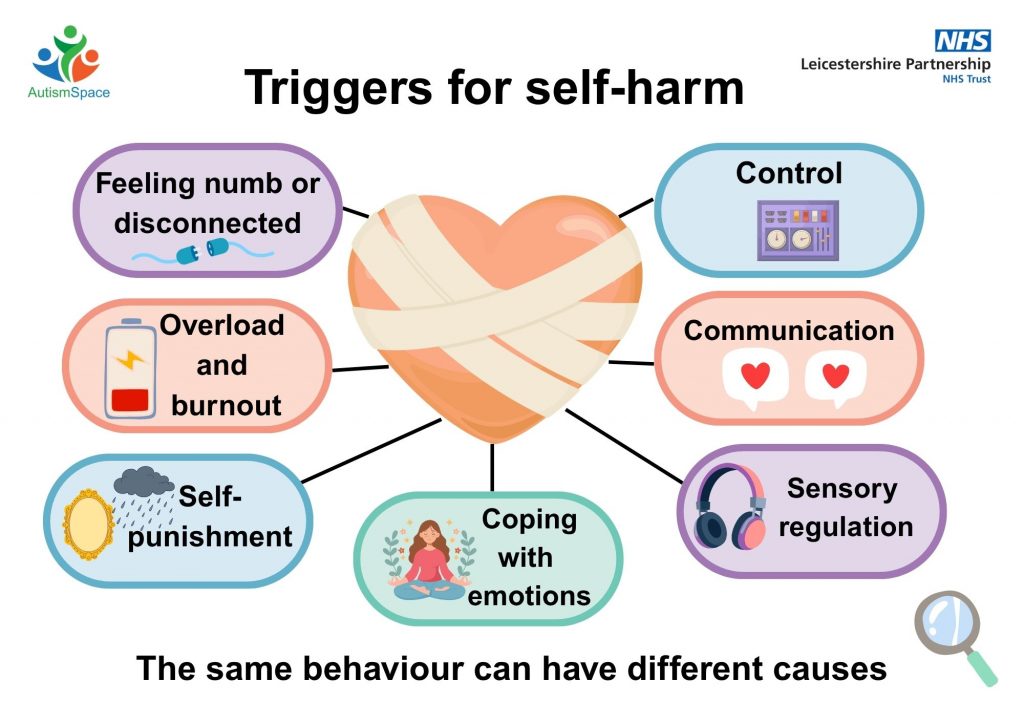
For a downloadable pdf click here: self harm triggers
It can help to notice patterns, keep a diary or journal.
Ask:
- What happened before the self-harm?
- Where did it happen?
- Who was present?
- What time was it?
- What was happening that day?
- Were there any changes to routine?
- Were sensory demands higher than usual?
Triggers might include:
- sensory overload
- unexpected change
- social demands
- conflict
- feeling criticised
- exam stress
- relationship problems
- fatigue
- burnout
- hunger or thirst
Example:
Self-harm happens most evenings after school. This may suggest the person is reaching the end of their ability to cope after a demanding day.
Key points
- Self-harm is a way some people cope with distress, overwhelming emotions or unmet needs
- Autistic people are more likely to self-harm, but autism does not cause self-harm
- Reasons may include emotional overwhelm, sensory overload, difficulties communicating distress, wanting control, feeling numb, or negative self-beliefs
- Self-harm and self-injurious behaviour are not always the same and may need different support
- Alexithymia can make it harder to recognise, understand and communicate feelings
- Understanding triggers, such as sensory overload, change, stress, fatigue or burnout, can help identify support needs
- Self-harm should be met with understanding and support, not judgement
Further information
Understanding how autism affects your thinking - and can consequently cause challenges, can also help you to improve your emotional wellbeing. There are many great books and websites that can help you.
For these resources, click here
For information on getting help in a mental health emergency or crisis, click here
For resources and services to support with emotional health and wellbeing including self-harm, click here
Whilst most of these services don’t specialise for autistic people, they should all make any reasonable adjustments needed. Consider sharing with a therapist about any individual autistic needs so they can make the necessary adaptations.
Also consider sharing this booklet produced by the National Autistic Society with your therapist.
NAS-Good-Practice-Guide-MH talking therapies, link to PDF here
Also, further advice on adapting health care for autistic people, can be found here