

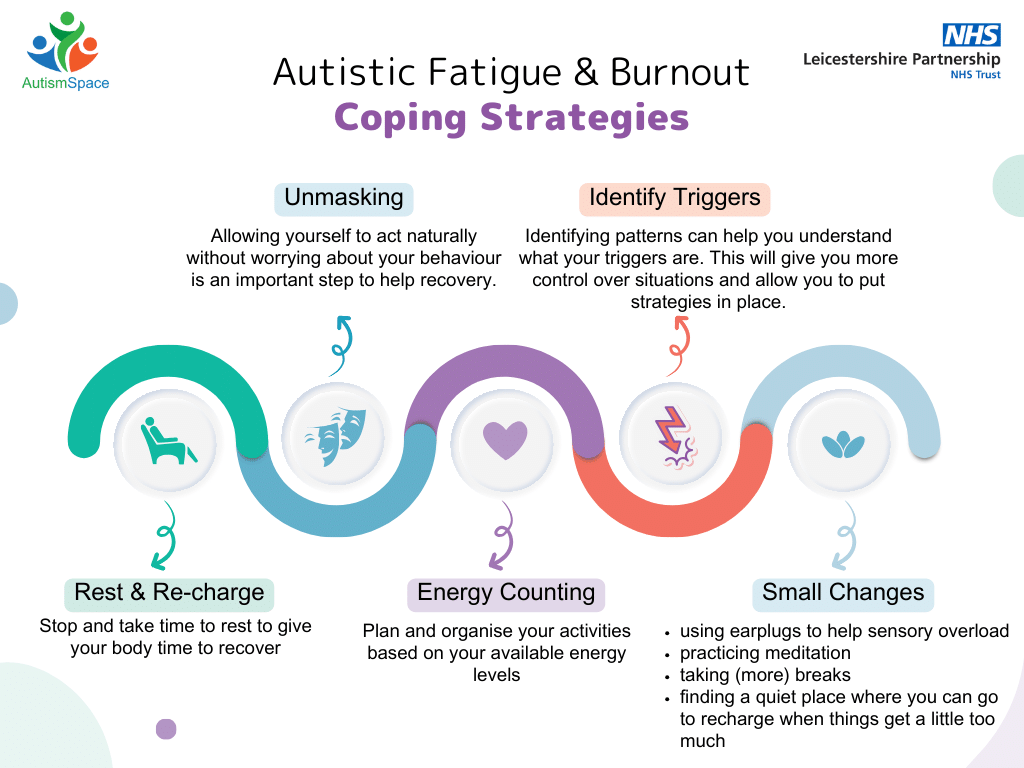
Click here to view or download this graphic as an accessible pdf
Plan ahead, spot early warning signs and recognise patterns
Planning when things are going well can make burnout easier to manage. A key part of this is learning to notice your own early warning signs and recognising patterns over time.
Early warning signs are the first small changes that show your energy and tolerance are starting to drop, such as feeling more tired than usual, finding everyday tasks harder or slower, becoming more sensitive to noise or people, or noticing slower thinking or brain fog.
These early signs are often linked to triggers, which are things that increase stress or use up energy, such as busy environments, social demands, changes in routine, or lack of sleep. Everyone is different, so it is important to get to know your own patterns and which triggers affect you most.
Burnout itself often follows patterns too. You might notice it:
- After busy periods
- After repeated demands
- At certain times of year
When you notice early warning signs, it is important to act early, rather than push through. This may mean reducing demands, taking time to rest, and using sensory or self-care strategies that help you feel calmer and more settled. Responding early supports your energy levels and helps your body’s stress system to recover, reducing the risk of burnout becoming more severe.
You can also use patterns to plan ahead.
You might:
- Do less before times you know are more demanding
- Plan recovery time after busy periods
You could:
- Notice your early warning signs, such as feeling more tired, overwhelmed, or slower in your thinking
- Identify common triggers that increase stress or reduce your energy
- Decide what to reduce or stop when signs appear
- Identify who can help and support you
- Plan regular rest and recovery time
Everyone’s warning signs and triggers are different, so it is important to notice your own patterns over time. Acting early, rather than pushing through, can help reduce the risk of burnout becoming more severe.
For parents and carers:
- Help notice and record patterns over time (for example, writing down when the person seems more tired or overwhelmed)
- Talk with the person to understand their early warning signs and triggers, and agree together what they would like to happen when these appear
- Support planning around predictable patterns (such as before and after busy periods or known difficult times)
- Support clear plans, such as what to reduce, who to contact, or how to create rest time
- Check in gently when you notice changes, without pressure or judgement
- Respect the person’s choices, preferences, and limits, even if they differ from your expectations
Reduce demands
Lowering demands helps your energy recover. Demands include work, chores, social plans, and busy or overwhelming environments.
You might:
- Take time off or reduce work or study
- Cancel or limit social plans
- Do fewer daily tasks
Focus on what is essential. Leave the rest for now.
For parents and carers:
- Help reduce expectations
- Take over or share tasks where possible
- Support prioritising what really needs to be done
Rest in a real way
Rest should be calm and low effort. It needs to give your body and mind a proper break.
Helpful rest might include:
- Sitting or lying in a quiet, dim space
- Doing a simple, familiar activity
- Taking breaks before exhaustion
Some people find mindfulness or meditation helpful. To find out more about this, click the following link:
www.leicspart.nhs.uk/autism-space/emotional-wellbeing/mindfulness-for-autistic-people/
Not all rest works for everyone. It can take time to find what helps.
For parents and carers:
- Help protect quiet time
- Reduce interruptions
- Avoid placing demands during rest
Comfort and sensory support
It can be helpful and restorative to do simple things that feel safe, familiar, and comfortable. These activities can support comfort, reduce stress, and help your nervous and sensory systems settle.
You might:
- Watch a favourite film or rewatch a series you know well
- Listen to familiar music or sounds
- Do sensory soothing activities (for example: hug a soft toy, use low lighting, or gentle movement)
- Eat favourite or comfort foods
- Wear your favourite or most comfortable clothes
- Use earplugs or headphones
- Lower lights or use softer lighting
- Spend time in quiet, predictable spaces
It can help to have a safe, quiet place to go when things feel too much. These activities are valid forms of rest and can support recovery.
For parents and carers:
- Support access to favourite items, activities, and calming environments
- Reduce noise, light, or other triggers where possible
- Avoid judging or limiting comfort choices
- Be flexible
- Recognise that familiar and sensory strategies can be an important part of recovery
Reduce or stop masking
Masking uses a lot of energy. Masking means hiding natural autistic behaviours or copying others to fit in.
Reducing masking might include:
- Stimming
- Communicating in a way that feels most natural to you – rather than how other people expect
- Spending time with people who accept you the way you are
Even small changes can save energy.
For parents and carers:
- Accept the person as they are
- Do not pressure them to “act normally”
- Support safe ways to express themselves
Focus on basic needs
When energy is low, focus on simple care. This supports the body and can reduce fatigue.
This includes:
- Drinking water
- Eating easy foods
- Sleeping when needed
It is okay to:
- Use ready meals
- Choose quick and easy options
- Lower expectations around meals and routines
For parents and carers:
- Offer food and drinks without pressure
- Help with preparing meals
- Gently prompt if needed
Use small steps
Tasks can feel too big during burnout. Breaking them into small steps can help.
The aim is to start with one small step. You might then feel able to do the next step. If you do not feel able to continue, that is okay. One small step is enough.
You might:
- Take one sip of water, then another if you feel able
- Open the door, then step outside if you feel able
- Wash hands, then wash face if you feel able
Even doing one small part of a task can help. Small steps make things feel more manageable.
For parents and carers:
- Suggest small steps rather than large instructions
- Avoid overwhelming the person with too many expectations
- Recognise that doing one small step is still progress
Ask for support
Support can reduce pressure and help recovery.
Helpful support includes:
- Help with chores
- Bringing food or drinks
- Listening without judgement
Supportive people:
- Do not place demands
- Avoid saying “you should”
- Understand that recovery takes time
For parents and carers:
- Offer help rather than waiting to be asked
- Be patient and understanding
- Focus on support, not pressure
Create flexible routines
Routines can help with structure, but they need to be flexible.
You might:
- Have set days for certain tasks
- Do tasks in smaller amounts
- Do tasks less often
Have a Plan B for difficult days. There is no single “right” way to manage routines.
For parents and carers:
- Be flexible when routines change or are not possible
- Avoid strict expectations
- Support adjustments when needed
Set boundaries
Setting boundaries means deciding what you will and will not accept, to protect your energy.
This includes saying no to requests from other people. You do not have to explain your reasons or feel guilty. Protecting your energy is important.
Examples include:
- Saying no to extra tasks or to things that feel too stressful or too much
- Saying no to requests from other people
- Leaving overwhelming environments
- Asking for adjustments
For example:
- “If it gets too noisy, I will leave”
- “I cannot take on extra work right now”
Boundaries help reduce stress and prevent further burnout.
For parents and carers:
- Respect boundaries
- Do not push beyond what the person can manage
- Help advocate for adjustments if needed
Gradual return to activity
Recovery takes time. Going too fast can make fatigue worse.
Try to:
- Start with small tasks
- Increase slowly
- Stop before exhaustion#
Each person will recover at their own pace.
For parents and carers:
- Encourage gradual return
- Avoid pushing too quickly
- Celebrate small steps
Be kind to yourself
Burnout is not your fault. It can be hard to see it coming or prevent it.
Being critical of yourself can increase stress. Being patient and kind to yourself supports recovery.
For parents and carers:
- Reassure the person
- Avoid blame or criticism
- Focus on understanding and support
When to seek extra help
If these strategies are not helping enough, and you are still struggling to function, or you are experiencing low mood, stress, or anxiety, it is important to seek extra support.
You can:
- Speak to your GP (doctor)
- Ask for help from a healthcare professional
- Check out our list of services that offer support for emotional wellbeing. You can find this here: www.leicspart.nhs.uk/autism-space/health-wellbeing-resources/
Getting support can help you access the right care and adjustments.
Key points
- Everyone is different and needs different strategies
- Reduce demands so they match capacity
- Fatigue is a key part of burnout
- Rest and quiet spaces can help recovery
- Easy, familiar, and comforting activities can help you get your energy back
- Focus on basic needs like food, water, and sleep
- Break tasks into small steps
- Support from others can make a big difference
- Parents and carers can help by reducing pressure and offering support
- Set clear boundaries to protect energy
- Return to activity slowly and at your own pace
- Be patient and kind to yourself
References
These sources support the ideas in this guide about autistic burnout, fatigue, and ways to support recovery. They are based on research, clinical guidance, and autistic people’s lived experience.
NICE autism guideline
National Institute for Health and Care Excellence (NICE) (2021)
Autism spectrum disorder in adults: diagnosis and management (CG142)
Available at: https://www.nice.org.uk/Guidance/CG142
- Explains how environmental demands, stress, and unmet needs affect autistic people
- Highlights the importance of adjusting expectations and support
- Recommends personalised care based on individual needs and capacity
Key research on autistic burnout
Raymaker, D.M. et al. (2020)
“Having all of your internal resources exhausted beyond measure”: defining autistic burnout, Autism in Adulthood, 2(2), pp. 132–143
Available at: https://pubmed.ncbi.nlm.nih.gov/32851204/
- Defines autistic burnout as chronic exhaustion, loss of skills, and reduced tolerance
- Explains that burnout happens when demands are too high and support is too low
- Supports strategies that focus on reducing demands and increasing support
Systematic review of autistic burnout
Ali, D. et al. (2025)
Burnout as experienced by autistic people: a systematic review, Clinical Psychology Review
Available at: https://www.researchgate.net/profile/Mackenzie-Bougoure/publication/397236526_Burnout_as_experienced_by_autistic_people_A_systematic_review/links/69169f1fd5ab34398c83933d/Burnout-as-experienced-by-autistic-people-A-systematic-review.pdf
- Confirms burnout as a serious and disabling state of exhaustion
- Identifies key factors such as masking, sensory overload, and long-term stress
- Supports the need for rest, reduced pressure, and supportive environments
National Autistic Society guidance
National Autistic Society (2022)
Understanding autistic burnout
Available at: https://www.autism.org.uk/learn/knowledge-hub/professional-practice/autistic-burnout
- Explains burnout in a clear, practical way based on research and lived experience
- Describes the impact of masking and high expectations
- Highlights the importance of rest, recovery, and acceptance of autistic needs
Additional context: mental health and stress in autism
Lai, M.C. et al. (2019)
Prevalence of co-occurring mental health diagnoses in the autism population, The Lancet Psychiatry, 6(10), pp. 819–829
Available at: https://www.thelancet.com/journals/lanpsy/article/PIIS2215-0366(19)30289-5/fulltext
- Shows higher rates of anxiety and long-term stress in autistic people
- Helps explain why fatigue and burnout risk can increase over time