
What autistic burnout is
Autistic burnout is a state of physical, mental, and emotional exhaustion that builds up over time. It happens when you keep coping with life without enough rest, understanding, or support.
It often includes:
- Extreme tiredness and fatigue
- Loss of skills, such as finding it harder to speak, cook, organise your day, or manage personal care
- Reduced energy
- Increased sensitivity to noise, light, touch, or people
- Feeling overwhelmed
Burnout is more likely when there are high demands and low capacity.
- Demands are the things life expects from you, such as work, school, socialising, travel, chores, and coping with sensory input
- Capacity is the energy, skills, support, and time you have to meet those demands
When demands stay high and capacity stays low for too long, burnout can develop.
Because everyone is different, one person may cope well with certain demands, while another person finds the same situation overwhelming.
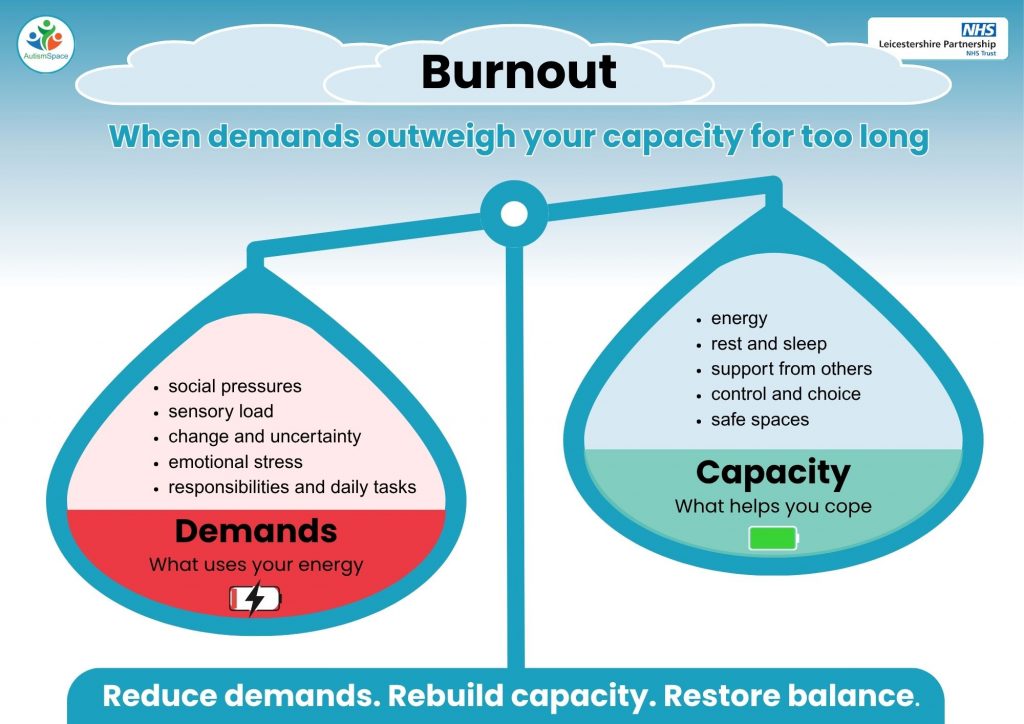
For a downloadable PDF of the above infographic click here: Burnout – demands and capacities
Autistic people are more at risk of burnout because:
- Environments are often not designed for autistic needs
- People may not understand autism
- Many autistic people mask
Support and adjustments are often limited
Here is a video with some of our clinicians talking about burnout:
Click here to view the transcript for this video
What masking means
Masking means hiding or changing your natural autistic ways of being so that you appear more like non-autistic people.
Examples of masking include:
- Forcing eye contact even when it feels uncomfortable
- Copying how other people talk or behave
- Hiding stimming (self-soothing movements like rocking or hand movements)
- Pushing yourself to socialise when you feel overwhelmed
Masking can help in the short term, but it uses a lot of energy and can increase fatigue, which can lead to burnout over time. It can also keep the body in a long-term stress state, with ongoing release of cortisol and adrenaline.
Why autistic burnout happens
Burnout is usually caused by a mix of pressures, and these will be different for each person.
Common causes include:
- Sensory overload, such as noise, bright lights, or crowded places
- Too much social interaction
- Masking for long periods
- High expectations at school, work, or home
- Life transitions, such as changing schools, starting a job, moving house, or changes in relationships
- Physical illness or chronic health conditions
Chronic conditions are health conditions that last a long time or keep coming back. These can increase fatigue and reduce capacity.
Examples include:
- Chronic fatigue
- Joint hypermobility or Ehlers-Danlos Syndrome (EDS)
- Migraines
- Digestive problems
Many autistic people have more than one physical condition at the same time, which can reduce energy further.
Long-term stress means the body’s hormones and brain chemicals may stay out of balance, making it harder to recover, even when demands reduce.
Some people may also find it harder to notice early warning signs due to:
- Interoception differences (difficulty noticing hunger, thirst, pain, or tiredness)
- Alexithymia (difficulty identifying or describing feelings)
Short-term and long-term burnout
Burnout does not look the same for everyone and can vary in length and intensity.
Short-term burnout
- May happen after a busy or stressful period
- Can follow a meltdown or shutdown
- Often linked to a temporary increase in demands
- Usually improves with rest
Long-term burnout
- Happens when stress continues over a long time
- Recovery can take months or even years
- Often includes ongoing fatigue and loss of skills
Early warning signs of burnout
Early warning signs are the small changes that show your energy and tolerance are reducing. These will be different for each person, so it is helpful to notice your own patterns over time.
Common early signs include:
- Feeling more tired than usual, even after rest
- Lower sensory tolerance (noise, light, touch, busy places)
- Reduced ability to cope with everyday tasks
- More shutdowns or meltdowns
- Trouble with thinking and focus (brain fog, slower processing)
- Loss of skills, such as speaking or organising
- Withdrawing more or needing extra time alone
- Increased anxiety or low mood
- Sleep changes, such as not feeling rested
In short, early signs often show up as growing tiredness, lower tolerance, and everyday tasks starting to feel much harder than before.
Noticing these signs early can help you pause, reduce demands, and rest, which may reduce the chances of burnout becoming more severe.
Signs of autistic burnout
Each person will have their own signs. Not everyone will experience all of these, and the severity can vary.
Thinking and communication
Changes in thinking and communication are often early signs and may increase with fatigue.
- Difficulty thinking clearly
- Slower processing
- Forgetfulness
- Struggling to speak, write, or understand
- Increased confusion
Daily tasks
Tasks that were once manageable can become difficult as energy reduces.
- Tasks take much longer
- Difficulty planning or organising
- Getting in a muddle
- Becoming more clumsy
To find out about strategies that can help with everyday tasks, click the following link:bit.ly/AS-DailyLifeSkills
Sensory and emotional changes
Your tolerance for sensory input and emotional stress may reduce.
- Increased sensory sensitivity
- Feeling overwhelmed more easily
- More tearful, irritable, or reactive
Masking and social interaction
You may find it harder to keep masking, especially when fatigued.
- Less able to mask
- Appearing more obviously autistic
- Social situations feel much harder
Sleep and physical health
Burnout affects the body and mind.
- Trouble falling or staying asleep
- Needing more sleep or not feeling rested
- Headaches, aches, digestive problems
- Feeling run down or getting ill more easily
These changes are linked to ongoing disruption to the body’s stress and sleep systems.
Autistic inertia
Many people experience autistic inertia.
This means difficulty starting, stopping, or switching tasks, even when you want to. Fatigue can make this worse.
Loss of interest
As energy drops, you may lose interest in things you usually enjoy.
- Losing interest in hobbies
- Not following usual routines
- Feeling flat or unmotivated
The impact of daily demands
Daily life can become overwhelming. Tasks like planning meals, working, or socialising may feel too much, especially when fatigue is present.
This can lead to a cycle:
- You feel tired, so tasks feel harder
- Tasks build up
- You feel stressed, guilty and/or have low self-esteem
- Your energy and capacity reduce further
This cycle can affect self-esteem and confidence, but it is important to remember this is a response to overload, not a personal failure.
Autistic artist Tzipporah Johnston has made a comic that illustrates this beautifully. Here is the first page:
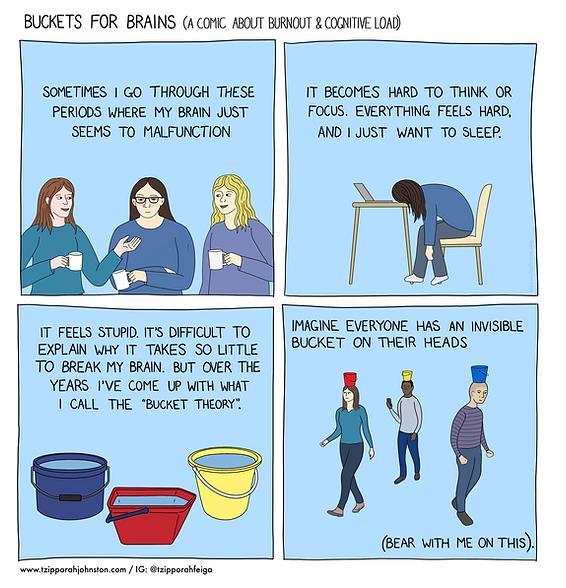
Click here to view the complete Buckets for Brains comic.
Click here to view Tzipporah Johnston’s website, which includes more of her autism related comics
Gentle, regular recovery helps the body’s systems settle. Enough sleep (supporting melatonin), quiet time, low demands, and safe sensory environments can help bring cortisol and adrenaline back to their usual daily pattern (higher in the morning, lower at night). Over time, this supports more balanced serotonin and dopamine, helping improve energy, mood, and focus.
Life transitions and burnout
Life transitions are times when things change, and they often increase demands.
Examples include:
- Moving from primary to secondary school
- Starting or leaving a job
- Moving house
- Changes in relationships
Different people will find different transitions challenging. Support and reduced demands can help during these times.
To find out more about what can help with transitions and changes, click the following link:bit.ly/AS-ChangeTransition
Autistic burnout and depression
Autistic burnout and depression can feel similar, but they are different.
Autistic burnout
- Caused by long-term stress and unmet needs
- Linked to environment and demands
- Often improves when demands are reduced
Depression
- A mental health condition
- Includes low mood, hopelessness, and loss of interest
- May not have a clear external cause
A person can experience both at the same time.
If you think you are experiencing autistic burnout, or want to find out how to try and avoid it, click the following link to find out how to help:
Key points
- Autistic burnout is deep exhaustion caused by long-term stress
• Fatigue affects both body and mind
• It involves changes in hormones and brain chemicals
• Burnout happens when demands are higher than capacity
• Everyone has different tolerance levels and stressors
• It can include loss of skills, low energy, and increased sensitivity
• Masking and unmet needs increase risk
• Early warning signs are individual and important to notice
• Signs affect thinking, communication, emotions, and physical health
• Burnout can be short-term or long-term
• It is different from depression, though they can overlap
References
These sources help explain what autistic burnout is, why it happens, and how it affects the body and mind. They are widely recognised, used in UK practice, or based on strong research evidence.
NICE autism guideline
National Institute for Health and Care Excellence (NICE) (2021)
Autism spectrum disorder in adults: diagnosis and management (CG142)
Available at: https://www.nice.org.uk/Guidance/CG142
- Explains how autistic people may be affected by their environment and daily demands
- Highlights the need to consider mental and physical health together
- Supports individualised, supportive care and understanding of needs
Key research defining autistic burnout
Raymaker, D.M. et al. (2020)
“Having all of your internal resources exhausted beyond measure”: defining autistic burnout, Autism in Adulthood, 2(2), pp. 132–143
Available at: https://pubmed.ncbi.nlm.nih.gov/32851204/
- One of the most important studies defining autistic burnout
- Describes burnout as chronic exhaustion, loss of skills, and reduced tolerance
- Links burnout to ongoing life stress and lack of support
Systematic review of autistic burnout
Ali, D. et al. (2025)
Burnout as experienced by autistic people: a systematic review, Clinical Psychology Review
Available at: https://www.researchgate.net/profile/Mackenzie-Bougoure/publication/397236526_Burnout_as_experienced_by_autistic_people_A_systematic_review/links/69169f1fd5ab34398c83933d/Burnout-as-experienced-by-autistic-people-A-systematic-review.pdf
- Reviews many studies involving thousands of autistic people
- Confirms burnout as a debilitating state of exhaustion and increased difficulty functioning
- Identifies key causes such as masking, sensory overload, stress, and unmet needs=
National Autistic Society guidance
National Autistic Society (2022)
Understanding autistic burnout
Available at:https://www.autism.org.uk/learn/knowledge-hub/professional-practice/autistic-burnout
- Provides a clear, practical explanation based on research and autistic experience
- Describes burnout as caused by chronic stress and mismatch between demands and capacity
- Highlights the role of masking, social pressure, and lack of support
Additional context: health and stress in autism
Lai, M.C. et al. (2019)
Prevalence of co-occurring mental health diagnoses in the autism population, The Lancet Psychiatry, 6(10), pp. 819–829
Available at: https://www.thelancet.com/journals/lanpsy/article/PIIS2215-0366(19)30289-5/fulltext
- Shows that mental health conditions, including anxiety, are more common in autistic people
- Helps explain why long-term stress can build and contribute to burnout risk