

The Care Quality Commission (CQC) has published a report on Leicestershire Partnership NHS Trust’s mental health crisis services and health-based places of safety, rating them as ‘Good’ following an inspection in May 2025.
The services were last inspected in October and November 2017 at which point they were rated as ‘Requires Improvement’, demonstrating a significant improvement since the regulator’s last visit. The CQC’s new report, published on Wednesday 18 March 2026, has rated the service as Good overall, with Good in all five domains that make up this rating – safe, responsive, and well-led, effective and caring – and no regulatory breaches.
Ratings table:
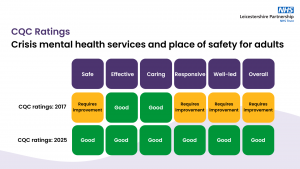
| Ratings | Safe | Effective | Caring | Responsive | Well-Led | Overall |
| Previous – 2017 | RI | Good | Good | RI | RI | RI |
| New – 2025 | Good | Good | Good | Good | Good | Good |
Angela Hillery, chief executive of LPT, said:
“We welcome the report published by the CQC, with an improved rating for our mental health crisis services and health-based place of safety from ‘Requires Improvement’ to ‘Good’. This is a huge achievement, and I could not be prouder of all the teams involved. The improved rating is a credit to their compassion and commitment, reflecting the immense positive progress we have made together, internally and with our partners.
“The CQC recognised many areas of high standards, including personalised care plans, a strong culture of safety and learning, safe clean environments, timely access to care and treatment, and good leadership. They have also recognised excellent practice in relation to equity in experiences and outcomes.
“I am proud that inspectors recognised that our staff treat patients with kindness, empathy and compassion. They have evidenced this in the report, sharing that most service users they interviewed spoke positively about the service, and described feeling safe, supported and listened to by our staff.
“We are committed to achieving good outcomes for all those who require support from our services, and to working with our patients, their carers, and our partners, in making a difference together.”
The CQC has identified many ‘Good’ areas within its report, some of which are highlighted below:
- A proactive and positive culture of safety, reflected through staff delivering safe, person‑centred care. Individual care plans are regularly reviewed by multidisciplinary teams and risks are managed well.
- Services operate from safe, clean, well‑maintained environments.
- People were treated with kindness, dignity and respect; they were involved as partners in their care and treatment, taking their communication needs and carers’ voice into account. Patients shared they felt safe, listened to and respected.
- Teams work well with other internal and external services, to meet patients’ needs and keep them safe, promoting joined‑up and flexible care that reflects local community needs.
- Staff wellbeing was well looked after by LPT, and there was a positive culture in which staff felt they could speak up if they had concerns and they would be heard.
- The service made sure people who used services could access care and treatment in a timely way. It met the national standards for assessment of emergency crisis referrals and calls to the 24-hour mental health helpline were answered within timescales.
- A strong culture of learning, improvement and innovation across the organisation. Complaints and incidents are taken seriously, investigated and lessons learnt.
- Leaders had the skills, knowledge and expertise to perform their roles. They were visible and inclusive and led with openness and integrity. The service had a shared vision, strategy and culture.
The CQC report gave the highest possible rating of 4, in relation to ‘equity in experiences and outcomes’, reflecting excellent practice in this area:
- “Staff and leaders actively listened to information about people who were most likely to experience inequality in experience or outcomes. This meant services were tailored to meet the needs of individuals and delivered to ensure flexibility, choice and continuity of care.”
- “The service had a health and inequality framework that had been recognised nationally as best practice.”
- “Examples included neurodiversity leads, sensory bags for learning disabilities and autism, and physical health checks undertaken out in the community.”
The CQC report will be published on its website on 18 March 2026.