

The Care Quality Commission (CQC) has published a report on our community mental health services for adults of working age, with a rating of ‘requires improvement’ following an inspection in May 2025. This is one of our 15 core services.
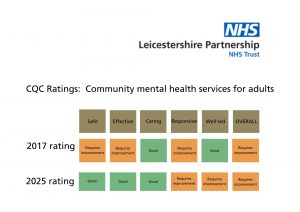
Improvements have been recognised since the last inspection with a “good” in three of the five domains that the CQC uses to make its assessment – safe, effective and caring – compared to two out of five when they last inspected adult community mental health services.
Positively, the inspectors found:
- Our staff treated patients with kindness, empathy and compassion, listened to them as partners in their care, and respected their privacy and dignity
- The service was effective at working well across teams in LPT and with other agencies to meet patients’ needs and to keep them safe
- Staff wellbeing was well looked after by LPT, and there was a culture in which staff could speak up if they had any concerns
- The service was good at learning lessons from safety incidents
- Staff assessed patients holistically, so they felt empowered and helped them live healthier lives
- The service understood the needs of its diverse populations and was working to tackle health inequalities.
They have outlined some areas for further improvement, which include:
- Patients were sometimes waiting too long for outpatient appointments and there were large caseload sizes in some teams
- There were some unfilled vacancies that were having to be covered by long term temporary staff
- Care and risk management plans were not always up to date and were not always sufficiently detailed.
The CQC wanted significant improvements to the waiting times for service users to access outpatient appointments and issued us with a Warning Notice, meaning they will come back to inspect us to ensure we are complying with this notice.
We have already begun to take action on reducing caseload sizes and we have significantly reduced the average wait for all outpatients from 133 days to 71 days. And although consultant shortages are a national issue, we are pleased to have appointed two new consultant psychiatrists and three more acting consultants since the inspection.
You can see from the table below the changes in the five standard CQC domains that make up the overall assessment.
We are pleased that the CQC found many examples of good practice, and a number of areas were identified as outstanding:
- ‘Delivering evidence-based care and treatment’
- ‘How staff, teams and services work together’
- ‘Partnership and communities’
Angela Hillery, chief executive of Leicestershire Partnership NHS Trust, said:
“Whilst the overall rating has remained at Requires Improvement, I am encouraged that our ongoing improvements have been recognised. The inspectors recognised many areas of high standards, and our services have been rated as ‘good’ for safety, effectiveness and caring.
We agree that our mental health outpatient waiting times need to improve and we have already made significant improvements by reducing these down by almost 50% since the inspection. And although consultant shortages are a national issue, we are pleased to have appointed two new consultant psychiatrists and three more acting consultants.
The CQC have evidenced that most service users they interviewed ‘spoke positively about the service and the staff. People described feeling safe and supported and having good relationships with staff.’ I am immensely proud that they recognised that our staff treated patients with kindness, empathy and compassion.
We will use the findings to continue with the improvements we have been making as part of our transformation programme to ensure good outcomes for all those requiring support from our services.”
You can read the full report on the CQC website, published 14 January.