

To find information and advice on health-related topics, for autistic people and their families, friends and carers, please click here
____________________________________________________________________________________________________________________________________________________________________
The listed services and links to websites maintained by other organisations are included on here to assist you and are provided in good faith. Some may incur costs. Their inclusion does not imply that the Leicestershire Partnership Trust endorses or supports them, nor does the absence of a service imply that we do not support them
____________________________________________________________________________________________________________________________________________________________________
Getting help to understand and find services
It can be hard to know which services are right for you. Different services have different rules about who can use them. If you are not sure where to start, there are local services that can help you work this out and connect you to the right support. Click the blue box below to find out how this works in in Leicester, Leicestershire and Rutland.
Getting help to understand and find services - in Leicester, Leicestershire and Rutland
Leicester
Local area coordinators (LACs)
Local area coordinators help you understand what support is available in your community. They can:
- listen to what matters to you
- help you plan what support you need
- connect you to local groups and services
- help you stay independent
To find contact details for Leicester LACs, visit: www.leicester.gov.uk/health-and-social-care/adult-social-care/local-area-coordination/
Social prescribers
Social prescribers (sometimes called link workers) help you with non-medical needs. They can:
- help you think about what support you need
- suggest services and activities
- help you contact services or make referrals
You usually access a social prescriber through your GP surgery. Ask your GP or reception team if this is available.
Leicestershire
Local area coordinators (LACs)
Leicestershire has local area coordinators working in different areas. They can:
- help you understand your options
- support you to find local services
- work with you to build a plan that suits you
You can find contact details for your area here: www.leicestershire.gov.uk/sites/default/files/2023-09/LAC-contact-details.pdf
Social prescribers
Social prescribers can support you to:
- understand your needs
- find the right local support
- get help to access services
You usually need to ask your GP surgery for a referral. Some GP practices may let you refer yourself, so check with your practice.
Rutland
Early support care co-ordination (ESCO)
Rutland has ESCO instead of local area coordinators. ESCO can help families to:
- understand what support is available
- coordinate services around your needs
- plan the next steps
You can contact ESCO by calling the Early Help Front Door on: 01572 758 493
Find out more here: www.rutland.gov.uk/rutland-information-service/directory/5u5059zklr0
Social prescribers
Social prescribers can help you:
- work out what support you need
- find services and activities
- access or apply for support
You can ask your GP surgery about social prescribing. They can tell you how to get an appointment.
Care Navigators for children and young people 0-19
Care Navigators at Leicestershire Partnership NHS Trust (LPT) help children and young people (0–19) and their families understand health services and find the right support.
They can:
- explain what services are available
- help you find the right support
- share information between professionals (with your consent)
- give updates about referrals and appointments
- be a point of contact if you are unsure what to do
They work across Leicester, Leicestershire and Rutland, with a care navigator in each area.
How to access
You can be referred by a professional (like a GP, school or health worker)
Some families can contact the service themselves
Phone: 0116 215 3269
Website: www.leicspart.nhs.uk/service/care-navigation/
Important
This service is mainly for children and young people (0–19)
They need your permission to share information
Summary
Care Navigators help organise and explain health support for children and families
Adults are more likely to get this kind of help from Local Area Co-ordinators (in Leicester and Leicestershire), and Early Support Care Co-ordinators ESCOs (in Rutland) – or from Social Prescribers (via their GP).
General health related resources for autistic people
Click the boxes below to find out more…
Autism - NHS
ToothPASTE free online resource – Supporting autistic children's oral health
ToothPASTE
ToothPASTE is a free online resource created with parents and professionals to support autistic children’s oral health.
It is also helpful for many children with additional needs.
The resource includes small, practical steps to help with:
- Toothbrushing
- Reducing sugary foods and drinks
- Attending dental appointments
The materials are autism‑informed, non‑judgemental, and simple to use.
You can also learn more about the research behind ToothPASTE.
For more information, please contact: A.Chauhan@leeds.ac.uk
Learning from lives and deaths (LeDeR)
LeDeR stands for Learning from Lives and Deaths of people with a learning disability or autism
It is an NHS programme in England that reviews the care and support autistic adults and adults with learning disabilities received if they sadly die. The aim is to review what worked well and what could be improved in the care they received.
By examining these cases, LeDeR helps services learn lessons –
– to prevent avoidable problems, improve future health and social care
– and make support safer and fairer for autistic people and those with learning disabilities
To find out more and / or to report the death of an autistic person or a person with learning disabilities, click the following link:
Report the death of someone with a learning disability or an autistic person
To see the latest reports from the Leicester, Leicestershire and Rutland LeDeR service, click the following links:
Pressure ulcers
Pressure ulcers can be of greater risk to people with a learning disability (which often co-occurs with being autistic) as they can have reduced movement, physical activity and sometimes lack the skills to understand and express that they may be feeling pain. LPT has created a leaflet about pressure ulcers to help individuals, family and carers look out for warning signs and what can help.
Neurodiversity Support CIC
Neurodiversity Support CIC is a not-for-profit, community-focused organisation led by people with lived experience of neurodivergent conditions.
They serve people in Leicester, Leicestershire and Rutland – and support children, young people, and families to feel seen, supported, and empowered.
They carry out a range of projects and run a number of groups and drop in sessions, including:
- Autism & Neurodiversity Club – opportunities to socialise and connect with others
- Employment Hub – hands-on work experience and confidence-building opportunities
- Pathways to Work – support with CV writing, interview preparation, and employment skills
- Health and wellbeing support – emotional support and wellbeing guidance
- Sports & fitness activities – activities that support physical and mental wellbeing
- Creative Space – arts and creative sessions that encourage self-expression
- Life skills support – practical support for everyday living skills
- Youth support – confidence-building and support for young people aged 14+.=
- Café Neuro (Cuppas and Connection) – social space to meet others and reduce isolation
- Community awareness events – activities that promote understanding of neurodiversity
- Cancer & neurodiversity support – specialist support for neurodivergent people affected by cancer
Find out more…
Website: www.neurodiversitysupport.org
Email: admin@neurodiversitysupport.org
Phone: 07946660929/07957377770/07749393755
Hospital and health care appointment resources
Click the boxes below to find out more…
University Hospitals Leicester Trust - Patient passport
University Hospitals Leicester Trust – Patient passports
Advice and support for parents and carers of autistic children visiting University Hospitals Leicester (UHL)
Going into hospital can be scary but patient passports can help make the process easier for everyone involved.
The patient passport provides important information for doctors, nurses and hospital staff in an easy-to-read form, promoting a positive experience for children with autism and /or with learning disabilities.
It means they can avoid certain things which upset the patient or do certain things to make them more comfortable. To download the patient passport please choose the correct one from the list below:
Click here to download the Children’s Patient Passport
Click here to download the Children’s Patient Passport – Easy Read format
The UHL website has comprehensive general information for parents and carers of autistic children visiting hospital.
You can find this here:
This page specifies what UHL hospitals advise when visiting their hospitals – and what support they can offer:
If you are a parent or carer whose autistic child needs support during a hospital visit, you can contact the Children’s Learning Disability and Neurodiversity Specialist Nurse on this number: 07484411873
___________________________________________________________________________________________________________________________________________________________________________________
Advice for autistic adults visiting University Hospitals Leicester (UHL)
Going into hospital can be scary but asking for reasonable adjustments can can help make the process easier for everyone involved.
For more information about how to make health appointments easier for autistic people, click this link:
UHL have a team of Acute Liaison Nurses who offer support for adults who are diagnosed with both a learning disability and autism. This team can be contacted here:
Email: learningdisabilities@uhl-tr.nhs.uk
Phone: 0116 250 2809
UHL do not currently have a support service available for autistic adults who do not have a learning disability.
The patient passport should contain all the information necessary for staff to respond to the patients’ needs and to understand them better. It means they can avoid certain things which upset the patient or do certain things to make them more comfortable.
Click here to download the Adult Patient Passport
Autistic adults without a learning disability are advised to do the following
- make a list of what you might find difficult in relation to your hospital visit
- make a list of what reasonable adjustments you would find helpful
- consider putting this into a health passport
- contact the department who have arranged the appointment
- do this in in plenty of time before the appointment, so that staff have time to make any necessary arrangements
- ask to discuss your needs – and negotiate the best way to meet these
Cheshire and Wirral NHS Trust checklist to help make health appointments accessible
Cheshire and Wirral NHS Trust checklist to help make health appointments accessible
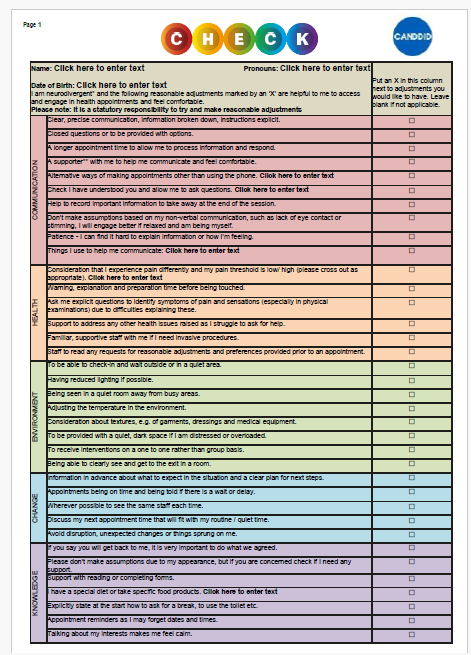
Cheshire and Wirral NHS Trust have designed a checklist to help make health appointments comfortable and accessible for neurodivergent people.
The checklist focuses on five main areas:
- Communication
- Health
- Environment
- Change
- Knowledge
Click here to view and download the checklist
For more information about how to make health appointments easier for autistic people, click this link:
The hospital discharge grant carers scheme
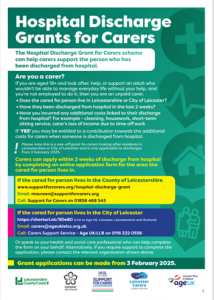
The Hospital Discharge Grant Carers scheme can help unpaid carers support any person who has been discharged from hospital – whether or not they are autistic
To qualify, the cared for person must live in Leicestershire or Leicester city and have been discharged from hospital in the last 2 weeks. The unpaid carer must have incurred costs linked to the discharge from hospital.
These costs can include cleaning, housework, short-term sitting service, purchase of equipment, or the carer’s loss of income due to time off work.
Carers can apply for this one-off grant by completing an online application form. Applications must be submitted within two weeks of the person being discharged from hospital.
For more information, including the online application forms, click the following links.
More Than Words - a resource to educate health care professionals on how to adapt their communication to meet the needs of autistic people
This resource is for health care professionals.
However if you are an autistic person who finds your communication needs are not being well met by any health care professional or service, you can consider sharing this document with them
Resources to help you make a complaint or get help to speak up
You have the right, by law, to make a complaint about any NHS care, treatment or service you receive.
Click this link to read more:
www.gov.uk/government/publications/the-nhs-constitution-for-england
You might want to share a compliment, ask a question, raise a concern or make a complaint about a health care service. If you need help to speak up, you might be able to use an advocacy service. An advocate helps you say what you need.
When you make a complaint, it is usually best to contact the service you used first. They can often sort things out quickly.
The services and resources listed below will help you find out how to make a complaint about a health care service – and ask for advocacy support, if you need to.
Click the boxes below to find out more…
Sharing compliments, comments, concerns, complaints or questions about your experiences with Leicestershire Partnership Trust
Sharing compliments, comments, concerns, complaints or questions about your experiences with a Leicestershire Partnership Trust (LPT) service
Option 1: Contact the service directly
Option 2: Contact the Patient Advice and Liaison Service (PALS)
How to contact LPT PALS
- Email: pals@nhs.net
- Phone: 0116 295 0830 – Phones are answered Monday-Friday, 9:00am to 4:30pm; or you can leave a voicemail anytime. They will respond to you as soon as they can.
- Post: Freepost LPT Patient Experience (Note: this is the full address and will reach the team)
For more information about PALS – and how to contact the team, click the following link:
www.leicspart.nhs.uk/contact/patient-advice-and-liaison-service-pals/
If you do not want to complain to LPT PALS, you can complain to the LLR Integrated Care Board (ICB) instead. The ICB acts as the organisation that pays for your care. Here are their contact details:
- Email: llricb-llr.complaints@nhs.net
- Phone: 0116 295 3405
- Post: Corporate Governance Team, NHS Leicester, Leicestershire and Rutland Integrated Care Board (ICB), Room G30, Pen Lloyd Building, County Hall, Glenfield, Leicester LE3 8TB
Make your complaint as soon as you can. Try to do this within one year of what happened, or within one year of when you found out about it.
You can make a complaint yourself, or for someone else if they give you permission.
If you have completed the NHS complaints process and you are still unhappy, you can contact the Parliamentary and Health Service Ombudsman (PHSO). They make the final decisions on NHS complaints. They offer a free and independent service. Here are their contact details:
- Phone: 0345 015 4033
- Website: https://www.ombudsman.org.uk
If you find it hard to make a complaint, consider using an advocacy service such as Ask Listen Do or POhWER (see below for details)
Complaints about NHS GPs (doctors), dentists, opticians or pharmacy (primary care) services in Leicester, Leicestershire and Rutland
Complaints about NHS GPs (doctors), dentists, opticians or pharmacy services in Leicester, Leicestershire and Rutland
These are called ‘primary care services’.
Option 1: Complain to the service directly
For example:
- your GP practice
- dental surgery
- optician
- pharmacy
Option 2: Complain to the LLR Integrated Care Board (ICB)
The ICB pays for (commissions) these services.
How to contact LLR ICB:
- Email: llricb-llr.complaints@nhs.net
- Phone: 0116 295 3405
- Post: Corporate Governance Team, NHS Leicester, Leicestershire and Rutland Integrated Care Board (ICB), Room G30, Pen Lloyd Building, County Hall, Glenfield, Leicester LE3 8TB
Make your complaint as soon as you can. Try to do this within one year of what happened, or within one year of when you found out about it.
You can make a complaint yourself, or for someone else if they give you permission.
If you have completed the NHS complaints process and you are still unhappy, you can contact the Parliamentary and Health Service Ombudsman (PHSO). They make the final decisions on NHS complaints. They offer a free and independent service. Here are their contact details:
- Phone: 0345 015 4033
- Website: https://www.ombudsman.org.uk
If you find it hard to make a complaint, consider using an advocacy service such as Ask Listen Do or POhWER (see below for details)
Complaints about NHS hospital services in Leicester, Leicestershire and Rutland
Complaints about NHS hospital services in Leicester, Leicestershire and Rutland (LLR)
Hospital services in LLR are mainly provided by University Hospitals of Leicester (UHL) NHS Trust.
Option 1: Contact the service directly
Option 2: contact UHL Patient Advice and Liaison Service (PALS).
How to contact UHL PALS:
- Phone: 0808 178 8337
- Email: uhl-tr.pals@nhs.net
If you do not want to complain to UHL PALS, you can complain to the LLR Integrated Care Board (ICB) instead. The ICB acts as the organisation that pays for your care. Here are their contact details:
- Email: llricb-llr.complaints@nhs.net
- Phone: 0116 295 3405
- Post: Corporate Governance Team, NHS Leicester, Leicestershire and Rutland Integrated Care Board (ICB), Room G30, Pen Lloyd Building, County Hall, Glenfield, Leicester LE3 8TB
Make your complaint as soon as you can. Try to do this within one year of what happened, or within one year of when you found out about it.
You can make a complaint yourself, or for someone else if they give you permission.
If you have completed the NHS complaints process and you are still unhappy, you can contact the Parliamentary and Health Service Ombudsman (PHSO). They make the final decisions on NHS complaints. They offer a free and independent service. Here are their contact details:
- Phone: 0345 015 4033
- Website: https://www.ombudsman.org.uk
If you find it hard to make a complaint, consider using an advocacy service such as Ask Listen Do or POhWER (see below for details)
Ask, Listen, Do – supporting feedback, concerns and complaints
Ask, Listen, Do – resources to support feedback, concerns and complaints
These resources help make health care and social care better for autistic people and people with learning disabilities.
What they do
- Help people share feedback, worries, or complaints about health care or social care
- Support families and paid carers to speak up too
- Encourage organisations to listen carefully
- Help services learn and make improvements
Who they are for
- Autistic children and adults
- People with learning disabilities
- Their families and carers
- Organisations that provide support and care
For more information about Ask Listen Do, click the following link: https://www.england.nhs.uk/learning-disabilities/about/ask-listen-do/
To watch a video about Ask Listen Do, made by NHS England, click the following link:
This video was not produced by Leicestershire Partnership NHS Trust and may contain adverts.
Ask Listen Do resources for autistic people
Click the following link for a booklet to support autistic people understand about sharing feedback or making a complaint: https://www.leicspart.nhs.uk/wp-content/uploads/2023/12/Ask-listen-Do-Autism-Booklet.pdf
Click the following link for the feedback, concerns and complaint form – for autistic people: https://www.leicspart.nhs.uk/wp-content/uploads/2023/12/Autism-feedback-concern-and-complaint-form.pdf
Ask Listen Do resources for people with learning disabilities
Click the following link for the Easy Read information about Ask Listen Do: https://www.leicspart.nhs.uk/wp-content/uploads/2023/12/Ask-Listen-Do-Easyread.pdf
Click the following link for the Easy Read feedback, concerns and complaints form: https://www.leicspart.nhs.uk/wp-content/uploads/2023/12/Easyread-feedback-concern-and-complaint-form.pdf
Ask Listen Do resources for families and carers
Click the following link for Ask Listen Do information for families and carers: https://www.leicspart.nhs.uk/wp-content/uploads/2023/12/Ask-Listen-Do-for-families-and-carers.pdf
Ask Listen Do resources for organisations
Click the following link for Ask Listen Do information for organisations: https://www.leicspart.nhs.uk/wp-content/uploads/2023/12/ask-listen-do-for-organisations-and-practitioners-v1.pdf
POhWER complaints and advocacy service
POhWER complaints and advocacy service
POhWER support people living in Leicester, Leicestershire or Rutland who need to make a complaint about an NHS or local authority (council) care service.
They can also support people who need support (advocacy) to help with things like social care assessments or issues in the community – when they need to speak out and are finding this difficult.
Their service is free and confidential – and it is independent of the NHS or local authority (council)
POhwer contact details:
- Telephone: 0300 200 0084
- Email: pohwer@pohwer.net
- Website information for Leicester City residents: www.pohwer.net/in-your-area/where-you-live/leicester-city
- Website information for Leicestershire County residents: www.pohwer.net/leicestershire
- Website information for Rutland County Residents: www.pohwer.net/rutland
Leicestershire Action for Mental Health Project (LAMP) - advocacy service
Lamp is an independent community mental health advocacy charity for the people of Leicester, Leicestershire and Rutland
Lamp provides free advocacy for people with mental health needs, including autistic people.
Support includes:
- Helping people to understand, navigate or challenge health, housing, benefits and social care systems
- Helping people to understand their rights and options
- Helping people communicate their views clearly and confidently
- Helping people work towards practical solutions to improve their wellbeing
Contact LAMP here:
Phone: 0116 255 6286
Email: advocacy@lampdirect.org.uk
Website: www.lampadvocacy.co.uk/
Eating related resources for autistic people
For more information click the following links:
Autism and eating disorders | Autism Space | Leicestershire Partnership NHS Trust
Click the boxes below to find out more…
Typical autistic eating differences
Autism Space information about typical autistic eating related challenges and habits
National Autistic Society – Top tips – supporting an autistic child with eating
Fussy eating in children – a series of webinars by NHS specialist paediatric dietitians to help guide parents when feeding children who exhibit fussy or restricted eating habits. These webinars have been submitted for BDA endorsement.
Advice for parents and carers for when their child refuses food
Book
How to Support Your Autistic Child with Food, Eating and Mealtimes: A Practical Guide for Parents, Carers and Other Supporting Adults – by Pooky Knightsmith

Disordered eating and eating disorders in relation to autism
Autism Space information in relation to disordered eating and eating disorders
The Peace Pathway is an organisation supporting autistic people with eating disorders. All the information they provide has been developed and learned through clinical experience. Their research suggests that around 35% of people experiencing an eating disorder may be autistic or present with high levels of autistic traits. They have developed the pathway to help support autistic people suffering with an eating disorder, their loved ones and their clinicians.
National Autistic Society – Information about autism and eating disorders
Autism Oxford – An autistic adult with disordered eating shares their lived experience – video
The Eating Disorders and Autism Collaborative is a UK-wide network of autism and eating disorders researchers. They aim to improve understanding of eating disorders in autistic people – and to help develop better treatments for them. They work collaboratively with autistic people with lived experience of eating disorders and have produced best practice guidelines for conducting research in this field. Check their website for details of their projects, including opportunities to get involved.
Local support for eating disorders
Here in Leicester, Leicestershire and Rutland there are several NHS services and healthcare pathways for people with eating disorders.
Your doctor will know if any of these are appropriate and can make any necessary referrals.
Click the following links for information about the Leicestershire and Rutland Adult Eating Disorders Service:
For adults
Information about the Adult Eating Disorders Service – Leicestershire Partnership NHS Trust
Leicestershire Adult Eating Disorder Service – home page
For children and young people
Nationally available support and resources for eating related issues
Improving your relationship with food and with your body
The Body Positive is a website containing a wealth of information, resources and advice on how to improve your relationship with food and your body.
Topics include:
- Selective eating and ARFID
- Body image and healthy eating
- Disordered eating
There are sections for young people, parents and carers and professionals – and there are stories from real people
The resources section links through to NHS endorsed resources, including blogs, top tips, events, workshops, webinars and videos
To find out more, click the following link:
https://bebodypositive.org.uk/
ARFID
Health for Teens information about ARFID
ARFID awareness UK charity home page – Raising awareness about ARFID, supporting individuals, families, carers and medical professionals, providing information, news, downloadable resources and online (Facebook) communities.
WHAT IS ARFID? – ARFID awareness’s explanation
ARFID – Avoidant/Restrictive Food Intake Disorder – information from BEAT, UK eating disorders charity
The Connection Between ARFID and Autism – information from US organisation FEAST
Autism Oxford – ARFID and autism – a video
Book
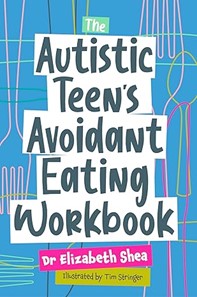
The Autistic Teen’s Avoidant Eating Workbook – by Shea and Stringer
This book is for neurodivergent teenagers looking to change their relationship with food – perhaps to expand their repertoire of ‘safe foods’, to get better at recognising and responding to hunger, or to reduce food related anxieties. This guide will help with this and many more aspects of eating related challenges. It includes top tips, a progress tracker and worksheets – and aims to support young autistic people to put themselves in charge of improving their food related habits, health and wellbeing.
Pica
Information about pica from BEAT eating disorders charity
Information about pica from the National Autistic Society
Other eating disorders
BEAT – Home page – This UK eating disorder charity providing a range ot support, information and advice. They have a phone helpline plus support via email, webchat and social media accounts. Calls to their helpline are free from landlines and mobile phones within the UK and do not appear on itemised bills.
BEAT – Tips campaign – signs of a possible eating disorder
BEAT – Going to the doctor – how to prepare for a doctor’s appointment about a possible eating disorder – and what you should expect
Book
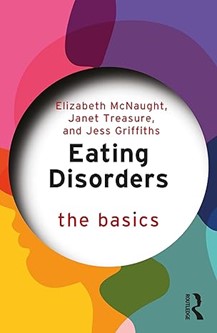
Eating Disorders – the Basics. By Mc Naught, Treasure and Griffiths.
This book is useful for people with eating disorders, their families, friends and also for health care professionals and students. It contains information about: risk factors that can cause and sustain eating disorders; assessment, diagnosis, treatment and support for people with eating disorders. It covers a range of relevant topics and contains real-life accounts – including from an autistic person.
___________________________________________________________________________________________________________________________________________________________________________________
Parenting Support
Click the boxes below to find out more…
Leicestershire | Togetherness
There are FREE parenting courses available through the NHS in Leicester, Leicestershire and Rutland (LLR) for any parent with an LLR postcode.
You will need to create an account to access the courses, by logging on to this webpage:
Free wellbeing online courses in Leicestershire – inourplace
https://togetherness.co.uk/mul/leicestershire/
You need to add the access code CURVE
The parenting courses cover a range of areas – and each have numerous modules which can be accessed and worked through at your own pace. These include:
· Understanding your child with additional needs
· Understanding your child’s feelings
· Understanding your child’s mental health and wellbeing
Support for hearing impaired people
Click the boxes below to find out more…
NHS 111 British Sign Language service
NHS 111 British Sign Language service
If you are deaf and have health needs, you can use the NHS 111 British Sign Language service:
___________________________________________________________________________________________________________________________________________________________________________________
The Leicestershire Partnership Trust cannot be held responsible for any damage or loss caused by any inaccuracy on linked sites or pages. The Leicestershire Partnership Trust cannot control and is not responsible for the privacy practices of any site to which a link is provided. It is recommended that you read the privacy policy of any site you visit, particularly if you are asked to give personal data.